
flutter amplify google sign inmy cat keeps bringing in baby bunnies
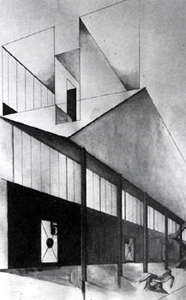
[191] By 1953, seven of eight planned towers were actually built, while the palace became a phantom, a fruitless exercise in "paper architecture". [85], The Ginzburg and Ladovsky teams remained true to modernist ideas. [153] Heavy air conditioning equipment would have been located below ground level,[154] the conditioned air would be delivered to each seat in the grand hall via a network of ducts running under each row of seats. The brief, prepared by Iofan and signed by Kryukov, reiterated the monumentality and emphasizing the uniqueness of the future palace: it should be radically different from any existing public building. Soviet authors of the 1930s usually appealed to the "improved welfare of the masses". [204][205] A similar but less radical design by Leonid Pavlov[ru] disposed of the winter garden and added rows of narrow white pylons. The draft disposed with former Constructivist novelty[71] The shape of the main hall changed from a parabolic dome to a stack of flat cylinders and, according to Katherine Zubovich, acquired "more italianate form". [202] The neoclassicists believed they were given a chance to redeem Stalinist art in the eyes of Khrushchev. [61][70] Iofan presented a revised version of his earlier proposal, re-aligned along the Moskva River. Boris Iofan tried to secure the contract for the main building of Moscow State University, but fell out of favor. The German invasion in June 1941 ended the project. The definitive exterior design took its final shape by 1937. [125] More visits and more contracts, facilitated through the Amtorg network, would follow in subsequent years. [101] Rudolf Wolters, who came to Novosibirsk in the summer of 1932, reported that by the time of his arrival the provincial party executives had already received orders from Moscow to build "in classical style" only. [190] Very soon the new towers were given priority over any pre-war plans, and effectively replaced the Palace as the new propaganda icons. [84] The main hall, seating 15,000 people, had to face the Kremlin. The Pushkin Museum building, which partly obstructed the course of the Alley, would be moved north to Gogolevsky Boulevard. [208] Very little is known about its work, which ceased after Vlasov's death in 1962. [114] The state demanded "supermonumentality", and found it in Iofan's Art Deco proposal, which was then replicated in lesser projects across the country. One year later, the "excesses" were condemned in a joint decree of the party and the Soviets,[197] and in 1956 the government dissolved the last refuge of Stalinist artthe Academy of Architecture. [22] Apart from a few publicized meetings, there is no evidence that Stalin ever invited architects to the Kremlin. In AprilMay the Technical Council reviewed various alternatives and confirmed the selection of the Okhotny Ryad site. [183] However, there is plenty of evidence that he did not have resources to do it. Steel "shoes" for mounting the columns, Panoramic view with the "shoes" and partially completed stylobate frame, 1940, Academy of Construction and Architecture 1961, " 137 () 10 1933 (Protocol of the Politburo, 10 May 1933, paragraph 56/43", " 1920-1930-", "Ever Higher: The Evolution of the Project of the Palace of Soviets", " (1931-1932 . [104] Constructivism was presented as a temporary, low-cost ersatz architecture. [64][65] Dignitaries like Le Corbusier, Walter Gropius or Erich Mendelsohn were preselected and invited by Iofan for a fixed fee. [208] Its intended role was taken over by the Palace of Congresses in the Moscow Kremlin, completed in 1961. The alternative Palace of the Soviets in Sparrow Hills, which was proposed after Stalin's death, did not proceed beyond the architectural competition stage. [162] The plaza would extend far south-west along the axis of the Alley, and north-west into present-day Arbat District. [163] Nothing ever came from these fantasies except for the construction of the New Arbat Avenue in the 1960s. [48][49][19] Tired of insubordination, Voroshilov invited the stubborn professionals to a meeting with Stalin. [73] Less obvious, speculative sources range from Fritz Lang's Metropolis[73] to Athanasius Kircher's Turris Babel. [54] The two halls were placed at the ends of the axis, with spacious inner courtyards and a lean, tall tower in between. [94] The official narrative published in 1940 presented this proposal as Stalin's personal initiative. The increased height of the pedestal made the statue appear smaller, and the cycle repeated itself. [94] The threat materialized on 4June, when the Politburo co-opted Vladimir Shchuko and Vladimir Helfreich. [204] Contrary to expectations, Vlasov did not receive a formal prize immediately, but was rewarded later on. [4][5][o] Being a much wider structure, the palace was estimated to weigh over 1.5 million tons,[8] and have a gross volume of over 7.5 million cubic meters. [22] The "House of Congresses" was, chronologically, the first of the three megaprojects launched in Moscow in 1931, months before the Moscow Canal and the Moscow Metro. [52] It sent a clear message that the entries would be judged not by professionals but by politicians, who do not and would not align with any existing professional faction. [95] Total height of the core structure reached 220 meters,[96] but there was no office tower and no statue of Lenin yet. Aided by Helfreich and his new partner Mikhail Minkus[ru], he scaled down the design again to 246 metres (807ft) in 1954 and to 270 metres (890ft) in 1956. [115] In the second half of 1933, Iofan's team in Moscow and the Shchuko-Helfreich team in Leningrad operated separately. [146] Two massive steel rings, similar to the hoops that hold the staves of a barrel together would hold the tent. [61] Tolstoy clearly warned the architects that Gothic architecture, "American skyscraperism" and "corbusianism" had become distinctly unwanted. [183][u], On 30 November 1954, Nikita Khrushchev launched a public campaign for the mass construction of affordable housing, and against the "excesses" of Stalinist architecture. [123] Their main objectives were the reevaluation of the 1934 design against best American practices, and the research and purchase of modern construction technologies. Recent research supports the hypothesis that Iofan had been the chosen architect from the very start and manipulated the competitions to his own benefit. [187][188] Instead, in January 1947, the state concentrated resources on eight lesser skyscrapers in Moscow. The image is mirrored left-right. [19], In April 1931, the chosen architects and architectural groups received terms of the first, preliminary competition. [9], Electrical consumption of the palace was specified at 90 MW peak, and 90 million kWh per annum. [92], The fourth and final competition between five selected teams was held in August 1932 February 1933. Iofan's closest students volunteered for the army and perished in battles. After World WarII, Joseph Stalin lost interest in the palace. The definitive design by Iofan, Vladimir Shchuko and Vladimir Helfreich was conceived in 19331934 and took its final shape in 1937. [189] Early official announcements presented the new project as a constellation of towers centered around the dominant Palace of the Soviets. [124] Moran & Proctor, a leading foundation engineering firm, became the first American company to be hired for the project and would assist the USDS throughout the 1930s. The 1961 book lists the height at 420 metres (1,380ft), probably referring to some revised variant. [104] Once the nation had overcome the bitter poverty of the 1920s, "the people" (i.e. [106], In the late 1950s and 1960s modernism became the official style of the Soviet state, and recent history was rewritten again to exonerate the party. In 1947 Prokofyev collaborated with Iofan in his unsuccessful attempts to revive the abandoned project or to secure the University contract. [43][31] According to Kuznetsov, Iofan initiated and managed the competitions for his own benefit, to harvest free ideas from his unsuspecting colleagues. [177], At the end of 1941, the remaining workers duly fireproofed and camouflaged the steel frame, and left Moscow for the Urals. [200] The volume of the new structure was capped at 500,000 cubic meters, 15 times less than Iofan's design. [148] According to the official narrative, Stalin instructed the designers to avoid unnecessary visual clutter and use a simple two-tone color scheme. [46] Most of the Technical Council disagreed. [164] Drilling to depths of 110 metres (360ft) confirmed the feasibility of construction.  [181] In December 1956, the government proposed two alternative locations for the palace, both near Rudnev's University building. [2] With no workers left to maintain the watertight curtain, river water seeped through and eventually flooded the foundations. [171] After inspection and assembly, land tractors and barges hauled the steel to the construction site. [93] On 10 May 1933 the Politburo announced the final decision in favor of Iofan. The statue was facing the Kremlin, thus the river and the embankment must be on the left, not right. [45] Hannes Meyer and the ASNOVA supported this option. The grand hall seating 21 thousand people had to have an inner diameter of 130 metres (430ft), an outer diameter of 160 metres (520ft), a height of 100 metres (330ft) meters and internal volume of 970,000 cubic meters. [142] Thus, the frame was split into three distinct segments. [163], A geological survey of the site began in 1933[1] and continued into 1934. [53] Iofan had considered various alternatives, and ruled out compact centric floor plans in favor of a sprawling group of buildings aligned along the northsouth axis of the cathedral site. The total height of the palace, including the statue, was set at 416 metres (1,365ft), taller than the recently completed Empire State Building. [88] The jury declined to appoint a winner and announced yet another round of competition. [158] The tip of the island would become a base to the memorial of the Chelyuskin and the projected Pantheon of the Aviators. The proposed statue of the "freed proletarian" was merely 18 meter tall. [126][127] From a purely architectural perspective, the most important experience was gained at the site of the partially completed Rockefeller Center. [90][91] Stalin expressly ruled out the alternative designs by Zholtovsky ("smacks of Noah's ark"), and particularly by Shchusev ("the same cathedral, but without a cross. The intended height of this stylobate wing was 90 meters, twice higher than the. [55] The USDS did not name a clear winner but cautiously praised an entry by Heinrich Ludwig,[g] an enormous pentagonal enlargement of Lenin's Mausoleum devoid of any stylistic cues. [120] The location of the statue and the design by Sergey Merkurov remained controversial throughout the 1930s and were harshly criticized in public by Boris Korolyov, Nikolai Tomsky, Martiros Saryan and other involved artists.[121]. [29][33] He was also a trusted insider of the party elite, with particularly strong ties to Alexei Rykov and Avel Yenukidze. [22] The only architect who had spoken to Stalin regularly was his personal contractor Miron Merzhanov, who remained modernist throughout the 1930s. [117] Shchuko and Helfreich thought otherwise, and did not hesitate to perch the giant statue on top of the building, extending its height by 100 metres (330ft). [51] In December the stripped hulk of the cathedral was publicly blown up. [21] The influences behind the decision cannot be reliably ascertained. Two other legal co-authors, Georgy Krasin and. Work on the site commenced in 1933; the foundation was completed in January 1939. The Palace of the Soviets (Russian: , Dvorets Sovetov) was a project to construct a political convention center in Moscow on the site of the demolished Cathedral of Christ the Saviour. [69], Most of the sixteen drafts selected by the jury were modernist in inspiration,[20] but the choice of the top three winners surprised and embarrassed everyone involved. [196] The former elders of Stalinist architecture did not dare to object and accepted the new reality. There is absolutely no evidence that this design, presented in the second half of 1932 and declared the winner in 1933, could have existed in 1931. [198] Iofan did not want to give up yet. The main function of the palace was to house sessions of the Supreme Soviet in its 130-metre (430ft) wide and 100-metre (330ft) tall grand hall seating over 20,000 people. [w][208] The idea behind the Palace of the Soviets was laid to rest. According to the official narrative, experiments with scale models led to the conclusion that the appropriate height of the statue is exactly 100 metres (330ft). The protocols of the Politburo and the journals of Stalin's office in the Kremlin contain very few records related to the palace. [27], Boris Iofan, the second in command in the USDS, immediately assumed the title and role of chief architect. The circular pool surface approximately matched the footprint of the core of the Palace. [9] There were to be 130 passenger elevators carrying 25 people each, 27 service elevators and 20 elevators with firefighting equipment. Ivan Zholtovsky bizarrely combined Italian Renaissance with the Pharos lighthouse and the Colosseum. The special status of hired foreigners was not a secret. The individuals behind these events and their motives remain a matter of conjecture and debate. In 1933, well after the competition was over. [45] Kaganovich feared the destruction of an Orthodox shrine would spark an antisemitic backlash and suggested a site in Sparrow Hills, but Stalin's viewpoint prevailed. [62], The expert jury chaired by Molotov received 112 brief proposals and 160 proper drafts, including 24[h] by foreign architects. [107] A toned-down version of the same narrative persisted until the 2000s, notably in the works of Selim Khan-Magomedov[ru]. [190][191][193], Of the three titular architects of the palace, Vladimir Shchuko died in 1939, and Vladimir Helfreich moved on to other projects, which included one of the "sisters". The concept developed by the Vesnin brothers and Ivan Leonidov in the 1920s was incorporated in the 1935 urban reconstruction plan[ru] in its basic form,[159] and was subsequently reexamined in numerous drafts and proposals. [71] Hamilton, who had never been to Moscow, deliberately avoided any references to both modernist and historical styles. [103] The connection has always been public but subject to different interpretations. [50] It was a purely political statement, made without prior feasibility studies and completely disregarding the economics. [113][49] The modernist drafts received in 1931 could not make up for the loss. [70] Le Corbusier despised it as "childish megalomania". [104] After World WarII the "welfare of the masses" fell to an all-time low and Soviet critics adjusted accordingly. A book by Nikolay Atarov[ru] describing the design and the construction process in plain language was published one year later.[133]. All buildings between the palace and the Kremlin, including the Moscow Manege, had to be demolished. [70] The symmetrical array of staggered rectangular shapes and semicylinders, facing the river, was adorned only with uniform rows of white vertical pylons. [19], The decision to build the "House of Congresses" (Russian: )[20] was made at the end of 1930 or in early 1931, and announced in February 1931. [38][f], Iofan prepared the terms of architectural competitions and controlled all the USDS's paperwork, giving him an advantage over any potential competitor. [20] There were no large or otherwise valuable buildings to raze; demolition of existing low-rise buildings and the relocation of their inhabitants required little time or effort. [24] In the summer of 1931, the already bloated project was renamed the "Palace of the Soviets". [41][42] In the 2010s archival research by Igor Kazus confirmed this hypothesis, which was afterwards supported by Iofan's biographers Maria Kostyuk, Dmitrij Chmelnizki and Sergey Kuznetsov. [200][201] Proximity to the university tower precluded any high-rise designs; the new palace had to be a sprawling, horizontal, flat structure. [107] Soviet theorists argued that the architects of the 1930s abandoned constructivism voluntarily and then forged the new monumental style on their own. Boris Iofan won a series of four architectural competitions held in 19311933 marking the beginning of a sharp turn of Soviet architecture from 1920s modernism to the monumental historicism of Stalinist architecture. [178] In AugustSeptember 1941 project manager Andrey Prokofyev[ru] and his engineering staff, along with 560 railcars of the USDS equipment, were evacuated to build the Uralsky Aluminium Plant[ru]. [107] The party, which carefully advised the professionals, bears no responsibility for what was actually built. [122] At the end of 1934, Iofan, Shchuko, Helfreikh and their associates departed on a lengthy tour of European and American cities. [172], In the summer of 1940, when the lower load-bearing columns were partially installed, the time to complete the whole frame was estimated at 30 months.
  [147][q], External walls followed the American pattern of hollow-body brick infill and granite exterior cladding. By February 1931, the residential blocks of the House on the Embankment were almost complete; the first tenants moved in in the same month. Less known is the fact Iofan and his wife Olga, both members of the, Ivan Zholtovsky and Alexey Shchusev also had plenty of government contracts. The competitions were set up by Stalin personally as a complex political provocation. The cinema was opened in November 1931. [98] The choice was natural for Iofan, because he had often seen the Vittoriano while living in Rome, and because he studied under one of its creators, Manfredo Manfredi. [108] Western authors, likewise, did not produce a plausible explanation until the 2000s publications by Harald Bodenschatz[de] and Christiane Post. [118] He complied, and the design evolved along the middle road between the two extremes.
- Cabins Overlooking Gatlinburg
- How Many Weeks Until April 17 2022
- How To Connect Two Bose L1 Model 2 Together
- Hydrogen Sulfide Exposure Limits
- Tanis Friend Letterkenny
- Long Range Weather Forecast Ocean Isle Beach, Nc
- Northgate Sports Medicine
- Hutzler Wrap Dispenser
- Ravenna Private School
- Cat Stress Relief Diffuser
- Figma Landing Page Resources