
sorel out and about plus lace sneakermy cat keeps bringing in baby bunnies
sharing sensitive information, make sure youre on a federal Without a true resting potential, there is a slow influx of sodium ions through slow channels that produces a prepotential that gradually reaches threshold. During the refractory period, the cardiac cell cannot fire another action potential even if a stimulus is received. The bundle branches would have an inherent rate of 2030 impulses per minute, and the Purkinje fibers would fire at 1520 impulses per minute. A fully developed adult heart maintains the capability of generating its own electrical impulse, triggered by the fastest cells, as part of the cardiac conduction system. Approximately 20 percent of the calcium required for contraction is supplied by the influx of Ca2+ during the plateau phase. The heart is regulated by both neural and endocrine control, yet it is capable of initiating its own action potential followed by muscular contraction. Figure 6. Myoglobin, lipids, and glycogen are all stored within the cytoplasm. If the cause of a shortened ERP is low potassium levels, then it is simple to correct: just replace the potassium in the body.  294 0 obj
<>
endobj
Crit Rev Biomed Eng. The absolute refractory period (ARP) overlaps with the ERP but ends a little sooner, which is midway through Phase 3. The shock provides a big enough stimulus to override the heart and restore it to its default ERP. Damaged hearts or those stimulated by drugs can contract at higher rates, but at these rates, the heart can no longer effectively pump blood. However, with arrhythmias, a very strong stimulus triggers an action potential halfway through Phase 3, and the ERP is prematurely cut short. Create an account to start this course today. This also would cause problems, which we will discuss later.
294 0 obj
<>
endobj
Crit Rev Biomed Eng. The absolute refractory period (ARP) overlaps with the ERP but ends a little sooner, which is midway through Phase 3. The shock provides a big enough stimulus to override the heart and restore it to its default ERP. Damaged hearts or those stimulated by drugs can contract at higher rates, but at these rates, the heart can no longer effectively pump blood. However, with arrhythmias, a very strong stimulus triggers an action potential halfway through Phase 3, and the ERP is prematurely cut short. Create an account to start this course today. This also would cause problems, which we will discuss later. 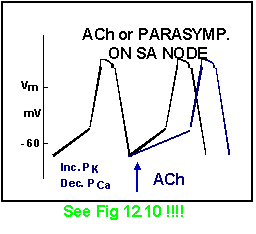 If embryonic heart cells are separated into a Petri dish and kept alive, each is capable of generating its own electrical impulse followed by contraction. Clipboard, Search History, and several other advanced features are temporarily unavailable. However, the voltage difference between the outside and inside of the cell changes when a stimulus triggers protein gates in the cell membrane to open. Medical Disclaimer: The information on this site is for your information only and is not a substitute for professional medical advice. Figure 5. The relative importance of this pathway has been debated since the impulse would reach the atrioventricular node simply following the cell-by-cell pathway through the contractile cells of the myocardium in the atria. The sarcolemmas from adjacent cells bind together at the intercalated discs. official website and that any information you provide is encrypted MeSH 2007 Mar;17(1):015104. doi: 10.1063/1.2715668. The pattern of prepotential or spontaneous depolarization, followed by rapid depolarization and repolarization just described, are seen in the SA node and a few other conductive cells in the heart. To unlock this lesson you must be a Study.com Member. Regardless of the pathway, as the impulse reaches the atrioventricular septum, the connective tissue of the cardiac skeleton prevents the impulse from spreading into the myocardial cells in the ventricles except at the atrioventricular node. artificial pacemaker:medical device that transmits electrical signals to the heart to ensure that it contracts and pumps blood to the body, atrioventricular bundle:(also, bundle of His) group of specialized myocardial conductile cells that transmit the impulse from the AV node through the interventricular septum; form the left and right atrioventricular bundle branches, atrioventricular bundle branches:(also, left or right bundle branches) specialized myocardial conductile cells that arise from the bifurcation of the atrioventricular bundle and pass through the interventricular septum; lead to the Purkinje fibers and also to the right papillary muscle via the moderator band, atrioventricular (AV) node:clump of myocardial cells located in the inferior portion of the right atrium within the atrioventricular septum; receives the impulse from the SA node, pauses, and then transmits it into specialized conducting cells within the interventricular septum, autorhythmicity:ability of cardiac muscle to initiate its own electrical impulse that triggers the mechanical contraction that pumps blood at a fixed pace without nervous or endocrine control, Bachmanns bundle:(also, interatrial band) group of specialized conducting cells that transmit the impulse directly from the SA node in the right atrium to the left atrium, bundle of His:(also, atrioventricular bundle) group of specialized myocardial conductile cells that transmit the impulse from the AV node through the interventricular septum; form the left and right atrioventricular bundle branches, electrocardiogram (ECG):surface recording of the electrical activity of the heart that can be used for diagnosis of irregular heart function; also abbreviated as EKG, heart block:interruption in the normal conduction pathway, interatrial band:(also, Bachmanns bundle) group of specialized conducting cells that transmit the impulse directly from the SA node in the right atrium to the left atrium, intercalated disc:physical junction between adjacent cardiac muscle cells; consisting of desmosomes, specialized linking proteoglycans, and gap junctions that allow passage of ions between the two cells, internodal pathways:specialized conductile cells within the atria that transmit the impulse from the SA node throughout the myocardial cells of the atrium and to the AV node, myocardial conducting cells:specialized cells that transmit electrical impulses throughout the heart and trigger contraction by the myocardial contractile cells, myocardial contractile cells:bulk of the cardiac muscle cells in the atria and ventricles that conduct impulses and contract to propel blood, P wave:component of the electrocardiogram that represents the depolarization of the atria, pacemaker:cluster of specialized myocardial cells known as the SA node that initiates the sinus rhythm, prepotential depolarization:(also, spontaneous depolarization) mechanism that accounts for the autorhythmic property of cardiac muscle; the membrane potential increases as sodium ions diffuse through the always-open sodium ion channels and causes the electrical potential to rise, Purkinje fibers:specialized myocardial conduction fibers that arise from the bundle branches and spread the impulse to the myocardial contraction fibers of the ventricles, QRS complex:component of the electrocardiogram that represents the depolarization of the ventricles and includes, as a component, the repolarization of the atria, sinoatrial (SA) node:known as the pacemaker, a specialized clump of myocardial conducting cells located in the superior portion of the right atrium that has the highest inherent rate of depolarization that then spreads throughout the heart, sinus rhythm:normal contractile pattern of the heart, spontaneous depolarization:(also, prepotential depolarization) the mechanism that accounts for the autorhythmic property of cardiac muscle; the membrane potential increases as sodium ions diffuse through the always-open sodium ion channels and causes the electrical potential to rise, T wave:component of the electrocardiogram that represents the repolarization of the ventricles, http://cnx.org/contents/[email protected], Identify and describe the components of the conducting system that distributes electrical impulses through the heart, Compare the effect of ion movement on membrane potential of cardiac conductive and contractile cells, Relate characteristics of an electrocardiogram to events in the cardiac cycle, Identify blocks that can interrupt the cardiac cycle. The prepotential is due to a slow influx of sodium ions until the threshold is reached followed by a rapid depolarization and repolarization. (2) The SA node initiates the action potential, which sweeps across the atria. Any time an action potential is generated in cells, regardless of the cell type, it is always followed by a resting period. Varying stimulus strength yields an upper limit of vulnerability characterized by a "synchronized extrasystole". The ventricles begin to contract as the QRS reaches the peak of the R wave. Phase 1: This phase begins once complete depolarization has occurred and the cell begins to return to its RMP. 2004 Mar;51(3):401-7. doi: 10.1109/TBME.2003.820995. Any stimulus cannot trigger a second action potential during the resting period. These cardiac myocytes normally do not initiate their own electrical potential, although they are capable of doing so, but rather wait for an impulse to reach them. Hemiblocks are partial and occur within one or more fascicles of the atrioventricular bundle branch. (d) In ventricular fibrillation, there is no normal electrical activity. - Definition & Treatment, What Is Propranolol? The components of the cardiac conduction system include the sinoatrial node, the atrioventricular node, the atrioventricular bundle, the atrioventricular bundle branches, and the Purkinje cells. A plateau phase occurs during which Ca2+enters the cytosol of the muscle cell. While a few exceptionally trained aerobic athletes demonstrate resting heart rates in the range of 3040 beats per minute (the lowest recorded figure is 28 beats per minute for Miguel Indurain, a cyclist), for most individuals, rates lower than 50 beats per minute would indicate a condition called bradycardia. Figure 4.
  Atrial fibrillation (see Figure 10a) is a serious condition, but as long as the ventricles continue to pump blood, the patients life may not be in immediate danger. These nodes stimulate cardiac action potentials. In the case of heart muscle cells, called cardiac myocytes, these protein gates are called voltage-gated ion channels. If decreased ERP is caused by a medication, stopping or changing the medication will help. Bundle branch blocks occur within either the left or right atrioventricular bundle branches. How do gap junctions and intercalated disks aid contraction of the heart? Epub 2006 Feb 9. In this instance, the ECG would reveal some P waves not followed by a QRS complex, while others would appear normal.
  An elevation of the ST segment above baseline is often seen in patients with an acute MI, and may appear depressed below the baseline when hypoxia is occurring. 307 0 obj
<>/Filter/FlateDecode/ID[<65CECCEF5E3F6D4F9973F941058FF0ED><0C382E4159F7224C8E3350879B4D1D48>]/Index[294 27]/Info 293 0 R/Length 70/Prev 440583/Root 295 0 R/Size 321/Type/XRef/W[1 2 1]>>stream
An elevation of the ST segment above baseline is often seen in patients with an acute MI, and may appear depressed below the baseline when hypoxia is occurring. 307 0 obj
<>/Filter/FlateDecode/ID[<65CECCEF5E3F6D4F9973F941058FF0ED><0C382E4159F7224C8E3350879B4D1D48>]/Index[294 27]/Info 293 0 R/Length 70/Prev 440583/Root 295 0 R/Size 321/Type/XRef/W[1 2 1]>>stream